fitfindr
A mobile fashion platform that connects discovery, outfit creation, and confident purchasing.
Context
FitFindr is a mobile fashion platform designed to connect fashion discovery, outfit creation, and confident purchasing in one experience.
Young shoppers increasingly discover clothing through platforms like TikTok and Instagram, but the journey after that inspiration is often fragmented. Finding an exact item, checking whether it will fit, comparing options, saving it for later, and figuring out how it works with an existing wardrobe can require several different apps and websites.
FitFindr brings those moments together through social media integration, personalized recommendations, outfit creation, verified product information, and a centralized Clothing Wallet.
The goal was to make fashion exploration feel more connected while giving users better tools to create looks and make confident decisions.
Insights
We started by understanding how young adults currently discover, evaluate, and shop for clothing online.
Our team conducted 8 semi-structured interviews and a survey with 14 participants, primarily Georgia Tech students who regularly use social media and engage with fashion at different levels. Interviews helped us understand the behaviors and frustrations behind shopping decisions, while the survey helped validate broader patterns.
Interviews
8 semi-structured interviews with people who shop for clothes through social media.
Survey
14 participants, used to check whether the interview patterns held more broadly.
What that meant for the design
Insight
Instagram, TikTok, and Pinterest are where fashion inspiration starts.
Decision
Let people capture a piece from the post that inspired them, without leaving the feed.
Insight
Fit, sizing, finding the exact piece, comparing prices, and knowing whom to trust slow people down. Reviews carry a lot of the purchase decision.
Decision
Put verified retailers, reviews, sizing, and a personalized Fit Score on the product itself.
Insight
People want to do more with clothes they already own. Outfit planning can cut decision fatigue without turning every visit into a new purchase.
Decision
Make outfit creation a core part of the product, mixing a wardrobe with new pieces.
The Problem
Fashion inspiration, outfit planning, and purchasing are often split across different tools.
A user might discover an outfit on TikTok, save the post or take a screenshot, search multiple retailers for individual pieces, compare sizing and reviews elsewhere, and then mentally figure out whether those items would work with their existing wardrobe.
Two goals became especially important. Participants described frustration with searching across sites, switching between apps, and inconsistent sizing across retailers.
Find it quickly
Get from a piece seen on social media to the actual item, without a scavenger hunt across apps.
Decide with confidence
Judge fit, reviews, and whether a piece works with clothes they already own before buying.
FitFindr brings those behaviors into one system, so someone can move from finding inspiration, to creating an outfit, to deciding what is actually worth buying.
Structure
The experience is organized around three parts of the fashion journey: discovering items, creating outfits, and making informed decisions.
Discover
FitFindr integrates with platforms like TikTok and Instagram so users can capture clothing directly from the content that inspired them.
A FitFindr action on fashion-related posts lets users save an item to their Clothing Wallet without losing their place in the social feed. They can also move directly into FitFindr when they want to explore the item further. That shortens the gap between seeing something interesting and being able to return to it later.
Create
The Outfit Maker is a place to try complete looks before making a purchase. Tops, bottoms, and footwear are shown together so each piece can be swapped independently while the full outfit stays visible.
Users can switch between Your Wardrobe, which uses clothing they already own or have added, and All Items, which introduces pieces available through FitFindr. A combination they like can be saved. FitFindr is then a styling and planning tool, not only a place to discover products, and a way to see how a potential purchase fits an existing wardrobe.
Save and decide
The Clothing Wallet is one place to return to saved products and outfits. Items sit in a stacked-card layout and can be filtered or expanded for more information.
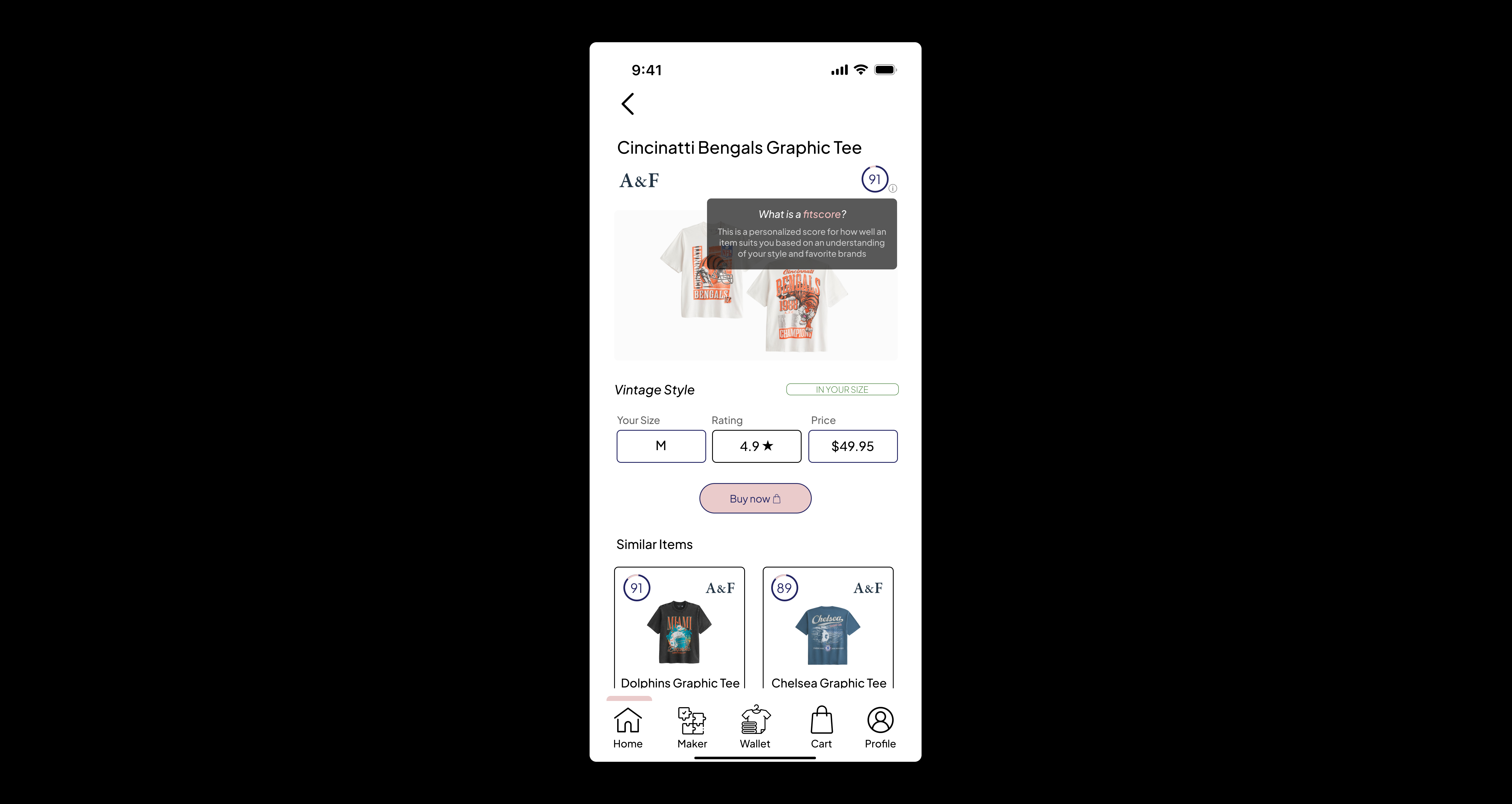
Product details and comparison tools surface verified retailers, reviews, sizing, and personalized Fit Scores. Research showed that reviews and fit information were the trust signals people relied on, so that information sits at the center of the experience.
Discover → Create → Save → Evaluate → Purchase
Wireframes
These wireframes are a snapshot of that loop, from a social post through the Clothing Wallet, Outfit Maker, and home.
.png)
Visual Design
Saving a piece from a post, opening the Clothing Wallet, and checking a product before buying.
.png)
.png)
Evaluation
We evaluated the high-fidelity prototype through a heuristic review and task-based think-aloud testing.
The prototype supported several of FitFindr’s core goals. Once people reached the Clothing Wallet and product detail screens, the visual organization was generally easy to understand. Text labels helped explain unfamiliar ideas such as verified retailers and Fit Scores. Interaction feedback and saved states reassured people that an action had gone through.
Feedback
Fit Score was unclear
Some people read it as a popularity rating rather than a personalized recommendation.
Clothing Wallet was hard to find
Several participants went to the wrong place, or asked where their saved items had gone.
Iteration
Those findings shaped the next pass. The work was less about adding features and more about making the system easier to discover, understand, and trust.
- An informational tooltip explains how Fit Score is calculated.
- Navigation and labels around saved items were clarified so the Clothing Wallet is easier to find.